
Evidence the Shroud of Turin Existed Centuries Before Carbon Dating
Countering the C-14 Date with Art, Coins, and Forensics
While the 1988 radiocarbon dating placed the Shroud of Turin in the medieval era, a substantial body of historical, artistic, and numismatic evidence strongly suggests the relic existed and was influential long before the 14th century. This evidence directly challenges the C-14 result.
1. The Sinai Christ Pantocrator Icon Connection (6th Century)
The Shroud's early influence on Christian art is best demonstrated by the Sinai Christ Pantocrator Icon and the subsequent universal change in Christ's depiction.
The Mandylion of Edessa and the Icon's Origin
In 525 AD, the holy Shroud (which many scholars identify as the Image of Edessa, or Mandylion) was reportedly discovered hidden above a gate in Edessa’s city walls.
Just six years later, a profound icon was produced at St. Catherine’s Monastery in the Sinai. This icon is widely considered to be the oldest surviving example of the classic image of Christ.
The Shift to the Bearded Christ
Prior to the 6th century, artistic depictions of Christ often showed him as a clean-shaven, youthful figure (the Christos Pantokrator, or Good Shepherd style).
Following the widespread circulation of the Mandylion (the face of the Shroud) in Edessa (c. 525 AD), depictions of Christ suddenly and universally changed across the Byzantine world. The new standard was a figure matching the unique features of the Shroud: the long face, long hair parted in the middle, and forked beard.
This dramatic and permanent shift in Christian iconography strongly suggests an authoritative template (the Shroud) became publicly available in the 6th century, over 700 years before the C-14 date.
Direct Copying of the Shroud's Features
The icon itself shows a direct link. Its facial proportions, trauma wounds, and unique anatomical details are so precise that scholars believe it is for sure based on the image on the Shroud:
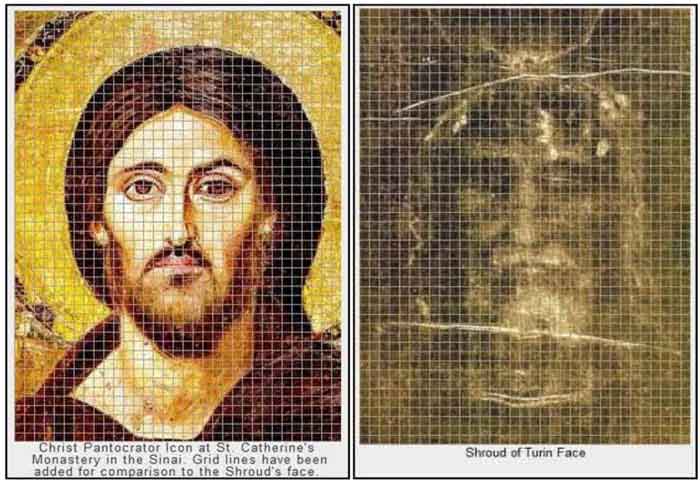
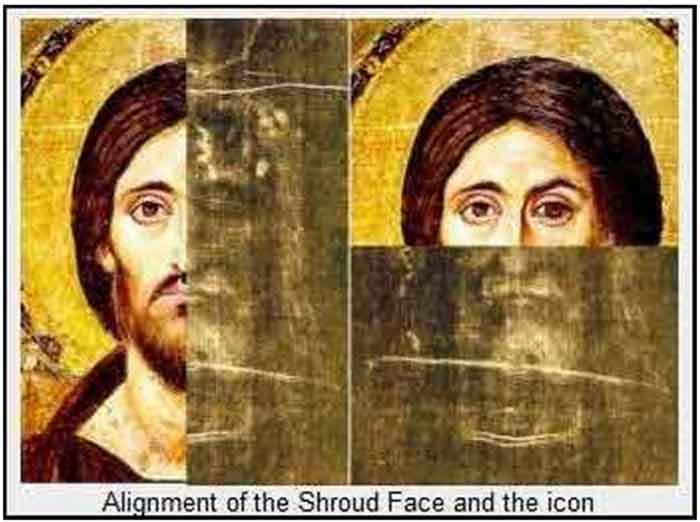
- The Christ Pantocrator icon (6th century)
- The facial asymmetry and unique proportions of the 6th-century icon align perfectly with the trauma and dimensions seen on the Shroud's image.
- This suggests the artist copied the unique facial trauma and dimensions seen only on the Shroud's image.
- The Shroud was a known template for Christian art centuries before the C-14 date.
2. Numismatic Evidence: The Justinian II Gold Coin (7th Century)
The Shroud's influence extended to imperial currency, providing irrefutable numismatic evidence of its early existence.
The First Naturalistic Image of Christ
The first gold coins ever issued with a naturalistic figure of Jesus Christ were produced in 692 AD, when the Byzantine emperor Justinian II (685–695 AD) issued the Gold Solidus coins.
The figure of Jesus on this coinage was based directly on the Shroud image. Dr. Alan Whanger, a leading Shroud researcher, discovered 145 points of congruence between the coin's image and the Shroud's image.
Unique Shroud Marks Copied on the Coin
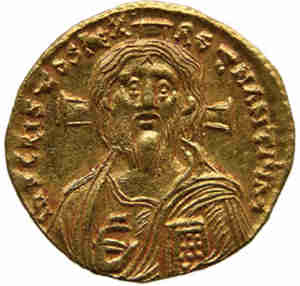
- The two strands of hair in the center of the forehead (mirroring a blood rivulet).
- The uneven length of hair on each side of the face (due to swelling or fluid).
- The large, solemn (owlish) eyes and pronounced cheekbones.
The existence of this detailed image in 692 AD is powerful evidence that the Shroud, or its influential prototype, was known and venerated centuries before the medieval period suggested by the 1988 carbon dating.
The Face on the First Gold Coin This 7th-century Gold Solidus coin is the first to bear a naturalistic image of Christ. The image is an exact match to the Shroud face, including trauma markings, proving the Shroud's influence and existence centuries before the Middle Ages.
3. The Sudarium of Oviedo: Independent Forensic Corroboration
The Sudarium of Oviedo, a small face cloth referenced in the Gospels, provides a critical independent forensic link to the Shroud's authenticity and early dating.
The Biblical Basis
The Gospel of John differentiates between the "strips of linen" (traditionally the Shroud) and the "cloth that had been wrapped around Jesus' head" (the Sudarium):
“...He saw the strips of linen lying there, as well as the cloth that had been wrapped around Jesus' head. The cloth was still lying in its place, separate from the linen.” (John 20:6-7, NIV)
The Sudarium (Latin for sweat cloth) has been venerated in the Cathedral of San Salvador in Oviedo, Spain, since the 8th century, and is historically traced back to Jerusalem in the 1st century AD.
Forensic Evidence: Sudarium and Shroud Match
Decades of analysis by the Spanish Center for Sindonology have investigated the relationship between the two cloths. The conclusions strongly suggest both covered the exact same head at different times:
- Blood Type Match: Both the Sudarium and the Shroud contain the rare blood of type AB.
- Bloodstain Congruency: Using advanced imaging, researchers proved the blood stain patterns on the Sudarium perfectly align with and are congruent over the corresponding stains on the Shroud's facial image.
- Trauma Match: Specific commonalities like an identical length of the nose (8 cm or 3 inches) and corresponding patterns of swelling and trauma connect the cloths.
- Sequential Use: Analysis indicates the Sudarium was used first (likely while the body was still on the cross), and was later replaced by the Shroud for burial.
- Pollen Evidence: Pollen samples extracted from both cloths match, including species indigenous to the Holy Land.
This body of evidence provides a powerful independent forensic link between the two relics, strongly supporting the claim that the Shroud of Turin is the genuine burial cloth of Jesus Christ and existed centuries before the medieval era suggested by C-14 dating.