
The Shroud of Turin: The 2,000-Year History of the Jesus Image Science Cannot Explain
The history of the Shroud of Turin is not a simple timeline, but a forensic chain of evidence connecting the cloth directly to the burial event described in the New Testament.
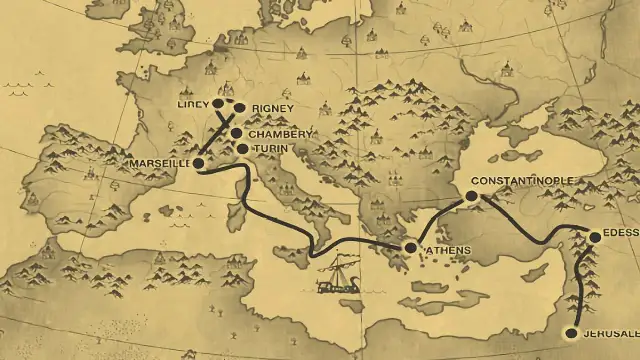
The Shroud's 2000-Year Pilgrimage: Tracing the Historical Route from Jerusalem to Turin
1. Biblical and Linguistic Origins (1st Century AD)
The earliest reference to the cloth is found in the Holy Bible, where the New Testament Gospels all mention the wrappings used for Jesus’s body.
A. The Costly Linen: The Word Sindōn
The New Testament Gospels of Matthew, Mark, and John mention the cloths used in Jesus's burial. All of them use the Greek word Sindōn to describe the fine linen cloth used by Joseph of Arimathea to wrap the body.
- Meaning: Sindōn signifies a costly, fine linen cloth.
- Eastern Origin: The term sindōn is believed to be derived from Sind (the Indus River valley) in India. This region was famous for its high-quality fabrics.
- The Shroud's Fabric: This linguistic connection is supported by the Shroud's fabric, which is a rare 3-over-1 herringbone weave, the most expensive type of linen of the time, making a medieval forgery highly unlikely.
B. The Dual Cloths: Shroud and Sudarium
John’s Gospel provides the most compelling forensic detail about the tomb scene (John 20:5-7), confirming the presence of two distinct cloths:
- The "linen cloths" (Greek: othonia) lying there, traditionally the main burial wrappings.
- The "cloth that had been wrapped around Jesus' head" (Greek: soudarion), which was "folded up in a place by itself."
This distinction between the othonia and the soudarion (sweat-cloth) is the basis for the belief that the Shroud of Turin and the Sudarium of Oviedo were both present in the tomb.
2. The Mandylion and the Lost Centuries (c. 30 AD – 1204 AD)
The history of the Shroud from the 1st century AD to the 13th century is pieced together by linking it to the legendary Mandylion (or Image of Edessa).
The Legend of King Abgar V
The earliest historical text on a cloth bearing Christ’s likeness comes from the 4th-century historian Eusebius of Caesarea.
- First Account: Eusebius records the tradition that King Abgar V of Edessa (modern Urfa, Turkey) asked Jesus for healing. The earliest account suggests a painter made a likeness.
- The Miracle: Later, more specific accounts describe Jesus pressing a cloth to His face, leaving a miraculous image (acheiropoieton—"not made by human hands") which cured the King.
The Shroud Folded: Mandylion
Many modern scholars believe that the Mandylion was actually a larger burial shroud folded in eight (the tetradiplon) so that only the face—the Vera Icona or "True Image"—was visible. Based on this view, the Edessa cloth preserved in the first millennium and venerated as the Mandylion is the same cloth that we now know as the Shroud of Turin.
- This Mandylion was transferred from Edessa to Constantinople in 944 AD.
Witness in Constantinople
Several sources confirm the existence of Christ's burial shroud in Constantinople prior to 1204:
- Custodian's Report (c. 1201): Nicholas Mesarites, the custodian of the Church of the Virgin of the Pharos in Constantinople, documented that among the relics there was "the burial shroud of Christ... said to bear the imprint of his dead body."
- Crusader Eyewitness (1203–1204): Robert de Clari, a French knight of the Fourth Crusade, reported seeing a shroud displayed upright every Friday, bearing the image of the Lord, at the church of St Mary of Blachernae.
After the sack of Constantinople by the Fourth Crusade in 1204, the shroud vanished from Byzantine records, leading many historians to believe it was carried to Western Europe.
3. Documented History in Europe (14th Century – Present)
The continuous, well-documented history of the Turin cloth begins in 14th-century France.
Lirey and the de Charny Family
- First Appearance (c. 1353–1357): The cloth is first recorded in the hands of the French knight Geoffroi (Geoffrey) de Charny. He had the shroud displayed as a relic in a church he built in Lirey, France.
Controversy and Transfer
- The Challenge (1389): Bishop Pierre d’Arcis of Troyes complained to the Pope, alleging an earlier investigation had found the cloth to be a man-made image and that an artist had confessed to creating it. Despite this controversy, the displays continued.
- The Savoy Dynasty (1453): Because of war and political turmoil, the cloth was moved around eastern France for safety. In 1453, Geoffroi’s descendant Margaret de Charny transferred ownership of the shroud to the House of Savoy, a powerful dynasty whose lands spanned parts of present‑day France, Switzerland, and Italy. Under Savoy protection the Shroud became a major dynastic relic, usually kept in Chambéry, the Savoy capital.
Arrival in Turin
The Fire and Repairs (1532): While kept in Chambéry, the Savoy capital, the shroud was damaged by a serious fire. The fire scorched the folded cloth and produced the well‑known triangular burn marks seen today. Poor Clare nuns carefully sewed patches over the damaged areas
Final Destination (1578): The cloth was eventually moved to Turin in 1578, where it has remained under the care of the Vatican ever since.